
Article written by Dr. Grant Jacobson and first appearing as a blog at hometownveterinarian.com, July 2026
Every pet owner deserves to understand what is included in a surgical estimate before making one of the most important decisions for their pet.

If you've ever wondered why one veterinarian charges $200 for a dog spay while another charges over $1,000, you're not alone.
Often, the biggest difference is what is included in your pet's care before, during, and after surgery.
Not every surgical estimate includes the same level of care. Differences in pre-anesthetic testing, intravenous fluids, anesthetic monitoring, pain management, nursing care, equipment, and recovery protocols can significantly affect both the cost of surgery and the care your pet receives.
Recently, I came across a social media post from a pet owner who was upset after receiving an estimate of approximately $2,000 to $4,000 for a CT scan. The post argued that veterinary hospitals should not be allowed to charge so much and even suggested there should be laws preventing what was described as "price gouging."
What surprised me wasn't the estimate. It was the comments.
Hundreds of people pointed out that advanced imaging requires sophisticated equipment, specialized training, and board-certified expertise. Most understood that a CT scan costs more than standard X-rays because it is fundamentally a different service.
Reading those comments made me think about another discussion I see repeatedly in local community social media groups.
Someone asks,
“Where is the cheapest place to get my dog spayed?”
or
“Where is the best place to get my cat spayed?”
Almost without fail, the answers focus on price.
That's when something clicked.
People naturally recognize that not all diagnostic tests are the same.
Far fewer realize that not all surgeries are, either.
With surgery, many people assume that because the final result is the same—a pet that has been spayed or neutered—the care provided along the way must also be the same.
It isn't.
Not Every Surgical Estimate Includes the Same Care
When most people compare prices, they're comparing the final outcome—a pet that has been spayed. Veterinarians, however, think about everything that happens before, during, and after that surgery. Those are the things that often account for much of the difference between two estimates.
In veterinary medicine, we often talk about the spectrum of care. While that phrase has become increasingly common within the profession, many pet owners have never heard the term or had it explained.
Most people would probably agree that if a family member were undergoing abdominal surgery, they would want blood work beforehand, intravenous fluids, careful anesthetic monitoring, effective pain relief, and attentive nursing care throughout recovery. Most pet owners would want exactly the same for their dog or cat.
The reality is that every one of those components adds cost, and every one of them can be reduced, modified, or omitted in an effort to lower the final estimate.
Different approaches involve different levels of testing, monitoring, pain management, and perioperative support. Those differences matter, and pet owners deserve to understand them before making an informed decision.
The important question isn't whether every pet requires every possible intervention. The important question is whether pet owners understand what is—and is not—included in the estimate they receive. Most pet owners are not veterinarians, nor should they be expected to know everything that goes into a safe anesthetic procedure. That's why informed discussion before surgery is so important.
If a complication occurs, many naturally assume that every patient received the same evaluation, the same monitoring, and the same level of care. Often, they don't realize there may have been important differences in what was included before the first incision was ever made.
Choosing a less expensive option should never be a source of embarrassment or judgment. The important thing is that the decision is an informed one. Pet owners deserve to understand what they are receiving—and what they may be giving up—before deciding which option is right for them.
Pet owners shouldn't be expected to know these differences. The responsibility is for veterinarians to explain them.
Where the Spectrum of Care Ends

Unfortunately, there are also situations that fall completely outside any acceptable standard of care. A nationally publicized case involved an unlicensed individual who was criminally charged after allegedly performing surgeries on animals, with multiple pets reportedly dying as a result. I have personally treated patients who were taken to individuals who were not licensed veterinarians because they offered to do surgery for less. These situations are thankfully rare, but they are real.
Equally troubling is the outdated myth that animals don't feel pain the way people do. Although modern veterinary medicine has thoroughly disproven this idea, pet owners still occasionally encounter individuals who claim that extensive pain medication isn't necessary or that sedation alone is adequate because animals supposedly don't experience pain like we do.
That is simply false.
Dogs and cats possess the same pain pathways and many of the same pain receptors that humans do. They experience surgical pain, they suffer when that pain is inadequately controlled, and modern veterinary medicine recognizes pain prevention and treatment as an ethical obligation—not an optional extra.
Thankfully, those situations are uncommon. They are not the focus of this article. The vast majority of veterinarians genuinely care deeply about their patients and strive to provide excellent medicine. My point is simply that the quality and scope of surgical care can vary dramatically, and pet owners deserve to understand those differences before making decisions based solely on price.
A Word About Low-Cost Spay and Neuter Clinics
Well-run nonprofit spay and neuter programs provide an invaluable service to both pets and their communities. Many of these organizations receive grants, donations, and charitable support specifically to make high-quality surgery available to families who might not otherwise be able to afford it. They perform an important service by reducing pet overpopulation while maintaining excellent standards of care.
However, just as with private veterinary practices, there can be differences between programs. Many low-cost clinics provide excellent care, while others may operate with different protocols or more limited resources. As with any veterinary practice, it is reasonable to ask questions and understand what is included in your pet's care.
If your financial circumstances improve in the future, consider giving back to those organizations so they can continue helping the next family.
Is Blood Work Really Necessary Before Surgery?
 Before anesthesia even begins, veterinarians must answer one question: Is this patient healthy enough for anesthesia?
One of the most common differences between surgical estimates is whether pre-anesthetic laboratory testing is included.
Recent studies have shown that routine laboratory testing identifies clinically significant abnormalities in approximately one out of every seven young dogs and one out of every five young cats. These are pets that often appear completely healthy during a physical examination.
Approximately one in ten of those patients require changes to their anesthetic plan based on those findings, and a small percentage have surgery postponed because proceeding would be unsafe.
Skipping laboratory testing lowers the cost of surgery, but it also means giving up information that may significantly reduce anesthetic risk.
Why Are IV Fluids During Surgery Often Required?
Once anesthesia begins, maintaining circulation becomes one of the anesthetist's most important jobs.
Another common difference between estimates is the use of intravenous fluids.
During anesthesia, IV access allows veterinarians to administer fluids that help support blood pressure, maintain blood flow to vital organs, and provide immediate access for emergency medications should an unexpected complication occur.
In veterinary medicine, IV fluids are sometimes omitted simply to reduce cost.
Approximately one out of every three dogs experiences low blood pressure while under general anesthesia. If prolonged or severe, low blood pressure can reduce blood flow to vital organs—including the kidneys—and increase anesthetic risk and the potential for permanent kidney injury.
IV fluids are one of the simplest and most effective tools veterinarians have to support circulation and respond quickly should problems occur.
Why Is Monitoring During Anesthesia So Important?
Even the safest anesthetic can become dangerous if changes aren't recognized early.
Monitoring isn't about collecting numbers.
- It is about recognizing problems while they are still small enough to correct.
- How do you know blood pressure has dropped if you aren't measuring it?
- How do you know oxygen levels are adequate without a pulse oximeter?
- How do you recognize a dangerous heart rhythm without an ECG?
Modern anesthetic monitoring allows veterinarians to identify changes early—before they become emergencies.
The only monitor that cannot help a patient is the one that was never attached.
How Much Pain Medication Should Dogs and Cats Receive After Surgery?
Pain doesn't begin when a pet wakes up. It begins with the first incision—which is why pain control should begin before surgery even starts.
Perhaps no area of veterinary medicine has changed more over the past two decades than our understanding of pain.
Today we know that untreated surgical pain is far more than simply uncomfortable. It delays healing, increases stress hormones, suppresses appetite, slows recovery, and may even contribute to long-term changes within the nervous system that make animals more sensitive to pain in the future.
Modern pain management begins before the first incision is made, continues throughout surgery, and extends well after patients return home.
For routine spays and neuters, current recommendations generally include a week or more of postoperative pain management—not simply until the patient wakes up.
Good pain management is also multimodal.
Rather than relying on a single medication, veterinarians combine long-acting opioids, anti-inflammatory medications, local anesthetics, and other techniques because each works differently. Together, they provide better pain control while minimizing side effects.
Many hospitals also use additional techniques, such as laser surgery and long-acting local anesthetics, to further reduce pain and improve comfort after surgery.
Pain relief should never be viewed as an optional add-on.
It is a core ethical responsibility of veterinary medicine to prevent and relieve pain whenever possible.
Dedicated Nursing Care Matters
One final difference that rarely appears on an estimate is nursing care.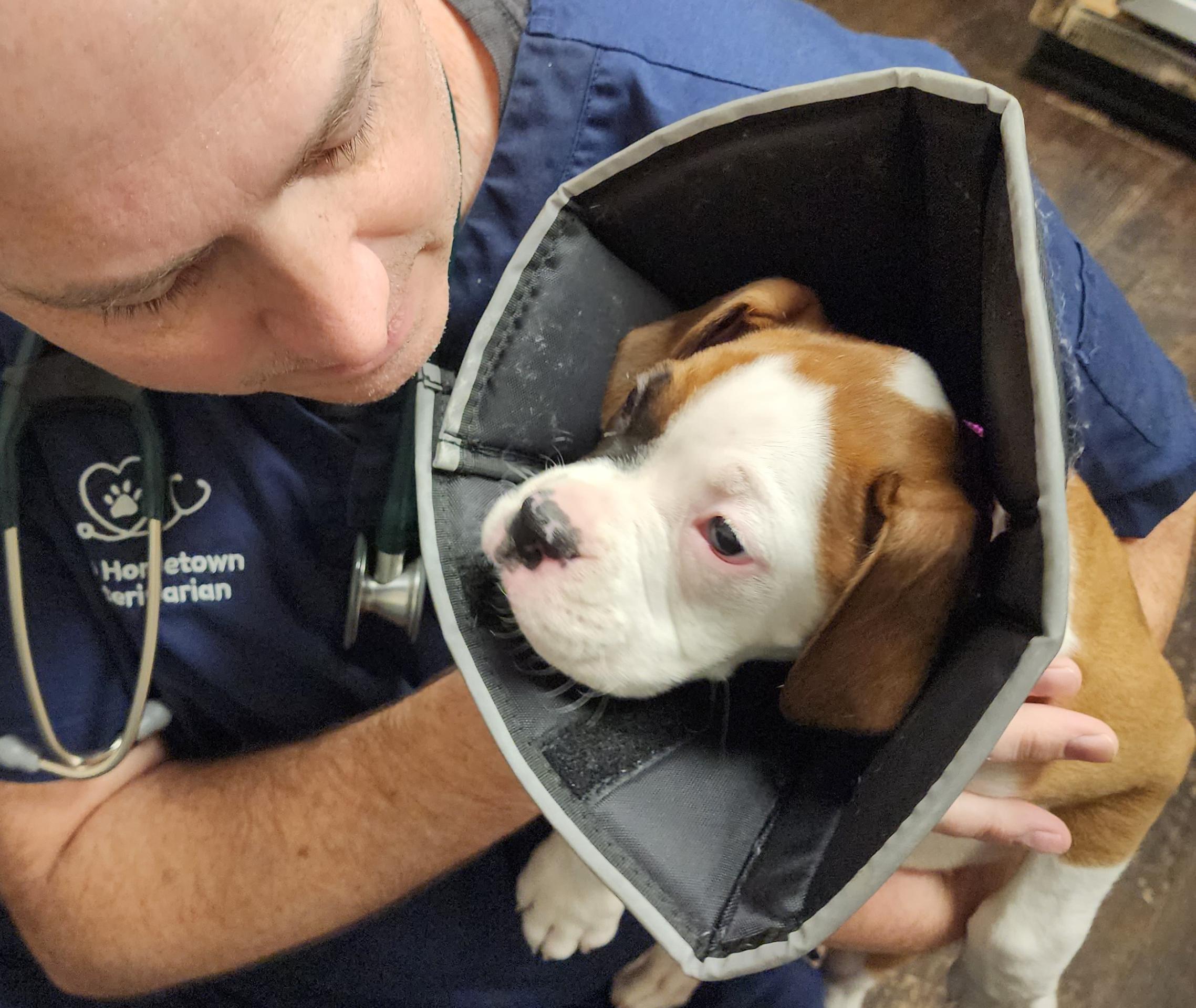
In some clinics, one technician may be responsible for several anesthetized patients at once. In others, one trained technician remains with a single patient from induction of anesthesia until the pet is awake, warm, comfortable, and safely recovering.
That veterinary nurse is continuously monitoring heart rate, respiratory rate, oxygen levels, blood pressure, body temperature, anesthetic depth, and comfort while responding immediately if anything changes.
Both facilities may advertise the same surgery.
The experience for the patient is anything but the same.
Questions to Ask Before Scheduling Your Pet's Surgery
You don't need to be a veterinarian to ask good questions.
- Will my pet receive a physical examination before anesthesia?
- Is pre-anesthetic blood work included or recommended?
- Will an IV catheter be placed?
- Will IV fluids be administered during anesthesia?
- How will my pet's blood pressure, heart rate, oxygen level, and breathing be monitored?
- Will a dedicated technician continuously monitor my pet from induction through recovery?
- What pain medications will be given before surgery?
- What pain medications will my pet receive after surgery?
- Approximately how many days of pain relief should I expect my pet to receive?
- If complications occur, what emergency equipment and medications are immediately available?
There are no wrong questions when your pet's safety is involved. A veterinarian who prioritizes patient care should welcome the opportunity to explain what is included in your pet's treatment plan.
The Bottom Line
The purpose of this article is not to suggest that the most expensive estimate is always the best—or that the least expensive estimate is always wrong.
The point is that veterinary medicine is not a commodity.
Two estimates for the same surgery may look remarkably similar on paper, but one may include pre-anesthetic laboratory testing, intravenous catheterization and fluids, continuous blood pressure and ECG monitoring, advanced anesthetic monitoring, multimodal pain management before, during, and after surgery, dedicated nursing care throughout anesthesia and recovery, and modern surgical techniques. Another may include far fewer of those services.
Both may be called a "spay."
As pet owners, you deserve to know the difference.
- Don't be afraid to ask questions.
- Ask whether blood work is performed.
- Ask whether IV fluids are used.
- Ask how your pet's blood pressure and oxygen levels are monitored.
- Ask what pain medications will be given during surgery and after your pet goes home.
- Ask who will be watching your pet while he or she is under anesthesia and recovering.
Those questions should never offend a veterinarian.
In fact, they should be welcomed.
Veterinary medicine is built on informed consent. A client cannot truly give informed consent if they don't understand the differences between two estimates.
My goal isn't to tell you which veterinarian to choose. My goal is simply to help you understand what you're choosing between.
Every pet owner should understand what is included in each estimate, ask thoughtful questions, and choose the option that best fits both their pet's needs and their family's circumstances.
The most important question isn't:
“How much does the surgery cost?”
It's:
“What does that price include?”
Evidence and Professional Guidelines
This article reflects current recommendations from major veterinary organizations and peer-reviewed research. If you'd like to explore these topics further, the following resources provide additional information: